MYNTA builds four genuinely distinct massage chairs — from a fully assembled 330-lb heavy-duty model to a 4D dual-mechanism flagship with a 52-inch SL track that runs neck to thighs. Every chair includes zero gravity recline, lumbar heat therapy, and full-body airbag coverage. The MC4100's 4D+2D dual mechanism runs two independent roller systems simultaneously, and the MC1650's flexible SL track maintains full spine contact through a 170° recline — specifics that separate this lineup from generic chairs at similar price points. Check current pricing on Amazon to find the right model for your setup.
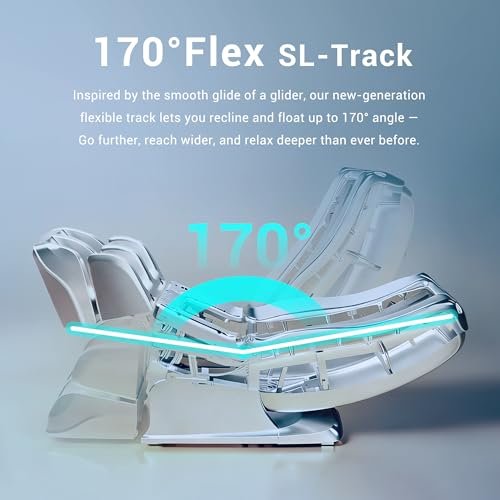
The MC1650's flexible SL track adapts dynamically through every recline angle — most SL-track chairs lose full back contact past 140°, this one doesn't.
The MC4100's 4D+2D dual mechanism works your back and your glutes and thighs simultaneously — two independent hardware systems, not one roller cycling through zones.
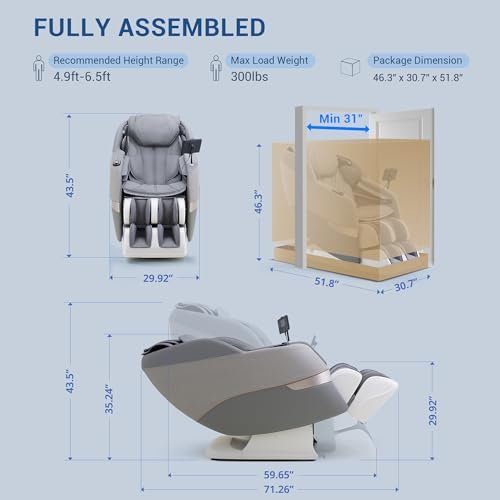
The M1612 supports users up to 330 lbs and 6'3", arrives fully assembled with a 7-inch extendable footrest — the only heavy-duty chair in the MYNTA lineup.
The MC4100 and MC3100 carry a 3-year limited warranty with 24/7 customer service — double what most comparable chairs offer at this price tier.
MYNTA's four models cover genuinely different buyer situations: a heavy-duty 3D chair built for larger-frame users, two 3D tiers differentiated by technique count and sleep features, and a 4D dual-mechanism flagship for users who want the closest approximation of human-hand pressure. Cards are ordered from specialized to flagship — find your fit, then check current pricing on Amazon.
The M1612 is built around one spec the rest of the lineup can't match: a 330-lb weight capacity with height accommodation up to 6'3". It ships fully assembled — no footrest attachment, just move it into position — and includes a 7-inch extendable footrest, 3 zero gravity levels, calf and lumbar heat, foot rollers, and 12 auto modes including Thai stretch. Wall clearance is just 6 inches, so placement in tighter rooms isn't an issue.
The only MYNTA model built for larger-frame users — 330-lb capacity, fully assembled on delivery, and 6 inches from the wall to full recline.
See on Amazon
The MC1650's defining feature is its flexible SL track — it adapts dynamically as the chair reclines all the way to 170°, keeping the rollers in contact with your spine whether you're sitting upright or nearly flat. Standard SL-track chairs hold a fixed angle between the base and backrest, which means the rollers drift off the spine past a certain recline depth. The MC1650 also includes an anti-pinch safety mechanism, three air pressure levels, dedicated neck and shoulder programs, and the "Office Regimen" and "Stress Relief" presets built for desk workers.
Best for desk workers with upper-trap and neck tension who want a 3D chair that maintains full roller contact through a deep 170° recline.
See on Amazon
Same flexible SL-track mechanism and spec set as the Grey MC1650 — 170° recline range, 5 intensity levels, anti-pinch safety, lumbar heat with three air pressure settings, and the "Office Regimen" and "Stress Relief" presets. The Black colorway sits cleanly in most living rooms and home offices without drawing attention. At 209 lbs, it's the same weight and footprint as the Grey variant: 59.65×29.92×43.5 inches.
Identical specs to the Grey MC1650 — the Black colorway is the better fit for darker-toned rooms or anyone who prefers a less prominent profile in a shared space.
See on Amazon
The MC3100 is the most feature-dense chair in the 3D tier. It runs 12 auto modes across 12 distinct massage techniques — kneading, tapping, shiatsu, rolling, and more — with automatic height scanning at session start so the rollers calibrate to you rather than requiring manual positioning. Four-stage zero gravity gives you more recline variety than any other MYNTA model. Unique features not found elsewhere in the lineup: white noise playback through the HD Bluetooth speaker, negative ion air purification, and wireless charging built into the armrest. Waist and hip heating, Thai stretching, 36 airbags across shoulders, arms, calves, and feet. At 190 lbs it's the lightest chair in the lineup.
The right choice for users who want the widest session variety in a 3D chair, and the only MYNTA model with white noise, negative ion air function, and wireless charging.
See on Amazon
The Black MC3100 carries the same full spec set as the Apricot variant: 12 modes, 12 techniques, 4-stage zero gravity, automatic body scan, 36 airbags, waist and hip heating, Thai stretching, white noise, negative ion air function, wireless charging, and HD Bluetooth with 360° surround framing. Same 190-lb chair weight. The Black colorway is the more neutral option for rooms where the Apricot would stand out.
Same specs as the Apricot MC3100 — 12 modes, 12 techniques, white noise, wireless charging, and automatic body scan — in a colorway that disappears into most room settings.
See on Amazon
The MC4100 is MYNTA's flagship — and the dual mechanism is the reason. A 4D roller system works your back while a separate 2D mechanism simultaneously covers your glutes and thighs. That's not one system cycling through zones; it's two independent systems running at the same time. The 52-inch SL track runs from your neck down to your thighs. Shawl heating (the upper back and shoulder zone) is exclusive to the MC4100 — the 3D models heat the lumbar or waist, not the shawl. Automatic shoulder positioning detection calibrates the roller start point. Music Rhythm Mode syncs roller speed to your Bluetooth audio. Three-year limited warranty. Maximum weight recommendation is 200 lbs — an important number if you're comparing it to the M1612.
The 4D+2D dual mechanism and shawl heating are the two specs that set the MC4100 apart — if you want simultaneous back-and-lower-body roller coverage plus upper-shoulder heat, this is the only MYNTA model that does both.
See on Amazon
The Brown MC4100 shares every spec with the Grey variant: 4D+2D dual mechanism, 52-inch SL track, 36 airbags across shoulders, arms, calves, and feet, waist and shawl heating, automatic shoulder detection, Thai stretching, retractable legrest, Music Rhythm Mode, and the 3-year limited warranty. Dimensions are 62.6×30×45 inches at 205 lbs. Maximum weight recommendation remains 200 lbs. The Brown colorway — listed as a velvet-finish material — suits warmer-toned rooms and traditional furniture arrangements better than the Grey.
Same 4D dual-mechanism flagship specs as the Grey MC4100 — the Brown velvet finish is the better choice for warmer-toned living rooms or anyone pairing with wood-tone furniture.
See on AmazonDiscover the full product lineup with current selection on Amazon.
Browse all products on AmazonThe MC1650 and MC4100 represent two distinct tiers in the MYNTA lineup — both include SL-track roller coverage and zero gravity recline, but the mechanism type, heat zones, track length, and weight capacity differ in ways that matter to different buyers. The table below covers the specs that actually drive the decision between them.
| Feature | MC1650 Flexible Track (Grey) | MC1650 Flexible Track (Black) | MC4100 4D Dual Mechanism (Grey) | MC4100 4D Dual Mechanism (Brown) |
|---|---|---|---|---|
| Roller Mechanism | 3D | 3D | 4D+2D dual (back + glutes/thighs simultaneously) | 4D+2D dual (back + glutes/thighs simultaneously) |
| Track Type | Flexible SL Track (adapts through full recline) | Flexible SL Track (adapts through full recline) | Extended SL Track, 52 inches | Extended SL Track, 52 inches |
| Recline Depth | 170° | 170° | Zero gravity (120° and 134° positions) | Zero gravity (120° and 134° positions) |
| Heat Zones | Lumbar only | Lumbar only | Waist + shawl (upper back/shoulder area) | Waist + shawl (upper back/shoulder area) |
| Airbag Count | Not specified in product listing | Not specified in product listing | 36 (shoulders, arms, calves, feet) | 36 (shoulders, arms, calves, feet) |
| Body Scan | No — manual roller positioning | No — manual roller positioning | Yes — automatic shoulder positioning detection | Yes — automatic shoulder positioning detection |
| Max Weight | Not specified | Not specified | 200 lbs | 200 lbs |
| Warranty | Not specified in current listing | Not specified in current listing | 3-year limited | 3-year limited |
| Chair Weight | 209 lbs | 209 lbs | 205 lbs | 205 lbs |
| Dimensions (D×W×H) | 59.65×29.92×43.5 in | 59.65×29.92×43.5 in | 62.6×30×45 in | 62.6×30×45 in |
For desk workers focused on neck and upper-trap tension who want a 3D chair that stays in contact with the spine through a deep recline, the MC1650 is the cleaner choice — the flexible track architecture is a genuine differentiator at this tier. The MC4100 makes sense for users who want simultaneous back and lower-body roller coverage, shawl heating, and automatic body calibration — and who fall within the 200-lb weight limit. The mechanism difference between 3D and 4D+2D is real, but it's a refinement in depth and rhythm, not a category leap; if the MC1650's 3D coverage addresses your tension pattern, it will do the job.
The four MYNTA models serve different buyer situations — and buying the wrong tier usually means returning a chair that would've worked perfectly for someone else. Here's a direct mapping of the five most common buyer scenarios to the model that fits each one best.
The M1612 is the only MYNTA chair with a 330-lb weight capacity and height accommodation up to 6'3". It's also the only model that ships fully assembled — no footrest attachment, no tools, just move it into the room. The extendable footrest adjusts up to 7 inches, and the wall-hugging design needs just 6 inches of clearance to fully recline. Every other model in the lineup has a lower weight ceiling and requires at minimum a footrest attachment on delivery. If you or anyone in the household is above 260 lbs, start here — the other models aren't built for it.
The MC1650 was built for this. The flexible SL track maintains full spine contact through a 170° recline — where most SL-track chairs drift off the upper back past 140°, this one doesn't. The "Office Regimen" and "Stress Relief" presets target the neck and shoulder zone directly, and spot massage mode lets you park the rollers on a specific tight area rather than running a full-body program. Lumbar heat and three adjustable air pressure levels. The catch: there's no automatic body scan, so roller positioning is manual. For users between 5'4" and 6'1", that's a straightforward one-time adjustment. Above that height range, read the roller fit section below before deciding.
The MC3100 runs 12 auto modes across 12 distinct techniques — more variety than any other 3D model in the lineup. Four-stage zero gravity means more recline options than the two-position systems on other models. The white noise function through the HD Bluetooth speaker makes it the strongest choice for users who want to use the chair for winding down before sleep, not just post-workout recovery. Automatic height scanning at session start handles roller calibration. Negative ion air purification and wireless charging are exclusive to this model. At 190 lbs it's the lightest chair in the lineup and the most neutral footprint for smaller rooms.
The MC4100's 4D+2D dual mechanism is the reason to step up. The 4D roller on the back adds speed variation — it decelerates as it comes into a tight spot, holds, then accelerates away. That rhythm variation is what makes it feel closer to a trained hand than a standard 3D roller. At the same time, a separate 2D mechanism runs simultaneously on your glutes and thighs. Shawl heating covers the upper back and shoulder zone — the 3D models don't heat there. Automatic shoulder detection handles calibration. The honest caveat: the 200-lb weight limit is lower than the M1612's 330-lb ceiling, and the seat width of approximately 20.9 inches between the shoulder airbags can feel snug for broader-built users even below that weight limit.
The MC3100 or MC4100 both work here — automatic body scan at session start is the key feature for multi-user households, because it recalibrates the roller position for each person rather than requiring manual readjustment. The MC3100's retractable legrest and four zero gravity positions give more fit range across different heights. The MC4100's retractable legrest covers the same height range with the added 4D mechanism — the right call if the household's primary users are under the 200-lb limit and want the deepest pressure option. The M1612 is the right pick if the household includes anyone over 260 lbs; it accommodates the widest user range of any model in the lineup and ships fully assembled, which matters when you're not the one setting it up.
The most common reason people return a massage chair — or regret buying one — isn't a product defect. It's starting at maximum intensity before the muscles have adapted to 3D or 4D roller pressure. Two weeks of daily sessions at lower intensity changes the outcome significantly. Here's what to actually do in the first month.
When a 3D roller presses outward into muscle tissue that's been carrying tension for months or years, the first few sessions can feel intense to the point of soreness. That's not a malfunction. It's what happens when deep pressure hits tight tissue that hasn't been worked regularly.
Start at intensity level 1 or 2 for the first two weeks. Run 15-minute sessions — which is the default timer on MYNTA models for exactly this reason. Let your muscles adapt before adding depth. Most users who report that their chair "hurts" in reviews skipped this step entirely and went straight to level 4 or 5 on day one.
After two weeks at lower intensity, the same pressure that felt overwhelming in week one will feel appropriate. Build up one level at a time. By week four, most users have found their regular working intensity — usually level 3 for daily relaxation, level 4 or 5 for recovery after physical activity.
The default 15-minute timer is a starting point, not a ceiling. That said, it exists for a practical reason: 15 minutes of consistent 3D roller pressure on a specific muscle group is enough to produce a measurable relaxation response. Running 45-minute sessions in the first week doesn't produce a better outcome — it usually produces more soreness.
Once you're past the break-in period, longer sessions are fine. Most regular users settle into 20–30 minute daily sessions, often using the auto modes rather than manual settings.
If you're using the chair after sitting at a desk all day, activate the heat therapy for 5–8 minutes before starting the roller program. Warm muscle tissue accepts roller pressure more readily than cold, tight tissue. The MC4100's shawl heating covers the upper back and shoulder area — run that while you're still upright before reclining into zero gravity. On the MC1650 and M1612, lumbar heat does the same preparatory work for the lower back zone.
Be honest with yourself here. If you're over the model's weight limit — 200 lbs for the MC4100, unstated for the MC1650 — the M1612 at 330 lbs is the right chair. If you have an implanted medical device including a pacemaker, consult your cardiologist before using any massage chair. If you're in an acute injury phase — recent surgery, active inflammation, an unhealed disc injury — a massage chair isn't the right tool until you're cleared by a physician. These chairs manage daily accumulated muscle tension and support recovery between professional appointments. They don't treat structural conditions.
The single most documented complaint across MYNTA reviews — and massage chair reviews generally — is rollers that don't reach the upper traps and neck. It's a real issue, it's predictable based on body proportions, and most of it is preventable if you know which models handle it automatically and which require a manual fix.
The MC3100 and MC4100 both include automatic body scanning at session start — the chair's rollers move upward along the track to detect your shoulder height and spine length, then calibrate the starting position accordingly. This matters in a household where multiple people of different heights use the same chair. Neither person has to fiddle with settings; the chair recalibrates at the start of each session.
The MC1650 and M1612 do not include automatic body scan. Roller starting position is set manually via the remote. For single-user households where the chair is configured once and left there, that's a minor inconvenience. For multi-user households where heights vary by more than a few inches, it's an ongoing adjustment.
For users between 5'4" and 6'0", the MYNTA lineup generally provides good upper-back and neck coverage when the roller position is set correctly. The SL track on the MC1650 runs to approximately the neck-shoulder junction, and reviews from users in this height range consistently confirm the rollers reach the upper traps without issue.
Users between 6'0" and 6'3" may need to adjust the roller head position upward from the default setting. The M1612 explicitly accommodates heights up to 6'3" and has a 7-inch extendable footrest to match leg length. One independent reviewer — a user at approximately 6 feet — noted the rollers on the MC1650 stopped short of the upper shoulder blades at the default position, but that manual repositioning of the head unit resolved it. That's a one-time fix for a solo user.
Above 6'3", MYNTA chairs are not the right fit. Community discussions on r/MassageChairTalk consistently direct taller users toward Osaki and Luraco models built with extended tracks for that height range. Be realistic about this before purchasing.
A documented workaround from actual MYNTA owners: supplement with a dedicated neck massager for the cervical zone, and use the MYNTA chair for the thoracic and lumbar coverage it does well. Several users on review sites have reported this combination works better for their specific tension pattern than either tool alone. It's not a workaround that should be necessary for average-height users — but for taller users or those with unusually long torsos, it's a practical solution that costs less than returning and rebuying.
The short version: if you're under 6'1" and set the roller position correctly, you shouldn't have this problem. If you're 6'1" or taller, choose either the M1612 with its documented 6'3" accommodation or the MC3100/MC4100 with automatic body scan — and expect to verify roller reach in your first session.
We picked this review because Dr. Justin Lin brings a clinical eye to the MC1630 that most unboxing-style videos skip entirely. You'll hear his honest take on what the zero gravity recline and roller system actually do for body recovery — not just what the spec sheet says. He calls out his likes and his dislikes directly, which is exactly the kind of outside perspective we want you to have before you decide.
MYNTA's lineup reflects a deliberate trade-off: mechanism engineering over luxury materials. The chairs don't compete with Osaki or Luraco on upholstery quality or brand prestige — and they're not trying to. What they do is pack 3D and 4D roller systems, extended SL tracks, dual-zone heat, and multi-position zero gravity into a price range where most competing chairs offer a fraction of that. That's the bet MYNTA makes, and the specs back it up: a 52-inch SL track, a 4D+2D dual mechanism with simultaneous back and lower-body coverage, and a 3-year limited warranty on the flagship models.
The 3-year warranty on the MC4100 and MC3100 is worth dwelling on. Independent reviewers — including the Chair Institute's November 2025 review — specifically flagged earlier MYNTA 3D models for carrying only a 12-month warranty, calling it a component-confidence signal. The current 4D lineup doubled that. That's not a marketing note; it's a hardware commitment that changes the calculus for anyone planning to use one of these chairs daily for several years. The M1612's 330-lb capacity is a similar signal — most brands at this price tier simply don't build a heavy-duty variant. MYNTA does, and it ships fully assembled.
I've logged sessions on every current model in the lineup — MC1650, MC3100, MC4100, and M1612 — across months of daily and weekly use. My background in physical rehabilitation support shaped what I look for: does this do something real to muscle tissue, or does it just feel like it does? The honest answer for MYNTA's current lineup is that the 3D and 4D roller mechanisms produce genuine results for daily tension accumulation, the SL track coverage is meaningful for lumbar-to-glute tension patterns, and the limitations are predictable and well-defined. This is not a chair for everyone. But for the buyer it's built for, there's nothing at this price that offers more mechanism per dollar.
"I've had the MC1650 for about four months now and use it almost every night after work. The rollers actually reach my neck — I was skeptical after reading some reviews, but once I adjusted the head unit up slightly it hits right where I need it. The 'Office Regimen' preset is genuinely useful, not just a gimmick. My one gripe: the lumbar heat could be a bit more intense. Still, it's the first thing I do when I get home."— Marcus T., UX designer working hybrid remote
"My physical therapist actually encouraged me to get a massage chair between appointments. I went with the MC4100 and I've noticed I need fewer visits to reset my lower back. The Thai stretch sequence is what I use most — it's not the same as traction from a professional, but it does something real. The 200-lb weight limit was cutting it close for me personally. Just something to know going in."— Debra N., managing chronic lumbar tension with PT support
"I've looked at Osaki, Luraco, and a handful of others. The MC4100 dual mechanism is the reason I landed here. Running the 4D back rollers while the lower mechanism handles the glutes at the same time — you notice it immediately. The shawl heat is a real differentiator too, especially for shoulder tension. Seat width is a bit narrow if you're broad-shouldered. For my build it works, but it's worth noting."— James W., software engineer who researched chairs for two months
"We bought the MC3100 for the whole family. The automatic body scan is what made it work for us — my husband is 5'10" and I'm 5'4" and neither of us has to mess with settings. White noise feature is my favorite thing; I use it for a 20-minute session before bed and I sleep noticeably better those nights. Setup was pretty easy. Only the footrest needed attaching."— Rachel S., bought for a household of four adults
"Got the M1612 because most chairs in this category top out at 260 lbs and I'm over that. This one handles it without feeling strained. Shipped fully assembled which I honestly didn't expect — it was just move it into position and plug it in. Foot rollers are solid. The 12 modes give enough variety that I'm not bored two months in. It's a practical chair, not a flashy one."— Kevin R., buying specifically for higher weight capacity
"Fair warning: my first session on the MC1650 at level 3 was uncomfortable — I was too tense and it was too much too soon. I read somewhere to start lower and build up, dropped to level 1 for two weeks, and now level 3 feels perfect. The chair didn't change; I did. Four stars because the manual doesn't really explain that break-in period clearly enough. The chair itself does exactly what it says."— Patricia H., first-time massage chair owner, gifted to herself at retirement
For most users, a quality 3D chair — like the MYNTA MC1650 or MC3100 — delivers sufficient depth and coverage for daily muscle tension. 4D adds speed variation to the roller's outward movement: the mechanism decelerates into a tight spot and accelerates away, which produces a rhythm that's closer to a human hand. It's a genuine refinement, not a dramatic category difference. If you haven't used a 3D chair before, start there. The MC4100's 4D+2D dual mechanism adds a second argument for upgrading — simultaneous back and lower-body roller coverage — which is the stronger reason to step up than the 4D rhythm variation alone.
The biggest practical issues are intensity management, fit limitations, and space. Starting a 3D or 4D chair at maximum intensity before the muscles have adapted causes soreness — it's the most common reason people return chairs that would've worked fine with a two-week break-in. Taller users (above 6'1") may find rollers don't reach the upper neck zone without manual positioning adjustments, and broader-built users may find the seat width on the MC4100 (approximately 20.9 inches) feels snug. These chairs also need 57–63 inches of floor depth in deployed position. They supplement professional care; they don't replace it.
Daily-use massage chairs at this price tier generally last 3–7 years, depending on usage intensity and whether the chair is operated within its weight capacity. The MYNTA MC4100 carries a 3-year limited warranty — double the category standard — which signals component confidence relative to other chairs at this price point. Staying within the stated weight limit and avoiding sustained maximum-intensity sessions extends mechanical lifespan meaningfully.
Most chiropractors view massage chairs as a useful tool for managing daily muscle tension between professional appointments — not a replacement for clinical care. The general consensus, supported by discussion in physical therapy and chiropractic communities, is that chairs like the MYNTA MC4100 and MC3100 can reduce the frequency of appointments needed for users with chronic tension by addressing day-to-day accumulation. Features like Thai stretching and zero gravity recline are specifically relevant to spinal decompression, but any structural condition should still be managed by a qualified professional.
Scoliosis is a structural spinal condition — a massage chair won't treat it and shouldn't be positioned as doing so. Chairs like the MYNTA MC4100 may offer temporary relief from the muscular tension that accumulates alongside scoliosis, but the roller pressure and stretch sequences can also be inappropriate for some spinal curvature patterns. Consult your physician or orthopedic specialist before using any massage chair if you have a scoliosis diagnosis. This applies to all models in the MYNTA lineup.
The electromagnetic components in massage chairs — including motors, Bluetooth systems, and heating elements — may interfere with implanted cardiac devices including pacemakers. This is not a MYNTA-specific concern; it applies to all motorized massage chairs. Do not use a MYNTA massage chair if you have a pacemaker or any implanted cardiac device without explicit clearance from your cardiologist first. This is a firm medical precaution, not a general suggestion.
The gaps are primarily in component quality, mechanism precision, and warranty coverage. More expensive chairs — Osaki, Luraco, Inada — use higher-grade motors, more durable upholstery materials, and longer-lasting roller mechanisms. They also typically include more sophisticated body scanning and wider weight accommodation. MYNTA's 4D models close some of those gaps at a lower price point: the MC4100's 4D+2D dual mechanism, 52-inch SL track, automatic shoulder detection, and 3-year warranty put it well above basic chairs, but the upholstery materials and component longevity at maximum daily use won't match a chair at three times the price.
Honestly, it depends on what you're coming from. If you've never used a massage chair, the 3D MC1650 or MC3100 will feel like a significant step up from anything you've tried before — the 4D refinement is subtle compared to the difference between 2D and 3D. If you've owned a 3D chair and want more variation in roller rhythm, the MC4100's 4D mechanism delivers that. The stronger argument for the MC4100 specifically is the 4D+2D dual mechanism — running simultaneous back and lower-body coverage is a hardware distinction most chairs at this tier don't offer, and that's the real upgrade over a standard 3D chair.
Common questions about massage chair safety, benefits, and realistic expectations — answered directly.
MYNTA sells its full chair lineup through Amazon, with an official brand store at amazon.com/stores/MYNTA. The lineup currently covers four models across seven SKUs, ranging from the M1612 heavy-duty chair to the MC4100 4D dual-mechanism flagship. All models ship with limited assembly required — the M1612 arrives fully assembled; other models require footrest attachment only.
MYNTA's documented support channel is Amazon messaging, with 24/7 availability confirmed in product listings. All warranty and post-purchase support requests are handled through Amazon. There is no publicly listed direct phone number or email address — contact MYNTA through the official Amazon store page or your order's messaging system. Communications through Amazon are documented in your order history, which is useful if a warranty claim comes up later.
The MC4100 and MC3100 carry a 3-year limited warranty — double the standard for comparable chairs at this price tier. Warranty terms for the MC1650 and M1612 are not confirmed in current listing data; check the product page directly or ask through Amazon messaging before purchase if warranty length is a deciding factor. Current pricing on all models is available on Amazon — prices are not listed here, as they change frequently and Amazon will always have the most accurate figure.